What’s the Difference Between a Cake Pop and a Cakesicle?
What’s the Difference Between a Cake Pop and a Cakesicle?
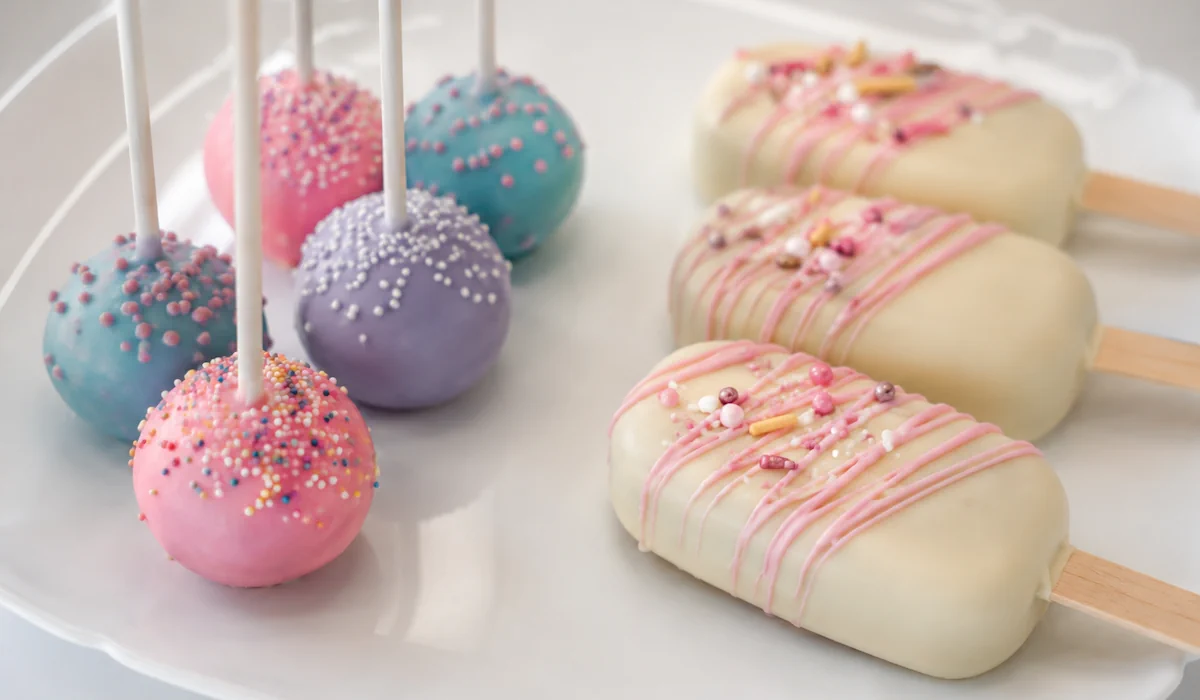
Both sit on a stick. Both get dipped in chocolate. Both show up at parties looking almost identical from across the room. Yet cake pops and cakesicles are made completely differently, taste different, and suit different occasions. If you’ve ever stood at a bakery counter unsure which one to order, here’s what actually separates them.
How a Cake Pop Is Made
A cake pop starts life as baked cake, usually the offcuts or crumbs from a larger bake, that gets crumbled down by hand. That crumb gets mixed with buttercream or cream cheese frosting until it binds into a thick, workable paste. From there, it’s rolled into small balls, chilled until firm, then pushed onto a stick and dipped in melted chocolate or candy melts.
The texture is the giveaway. Bite into a cake pop, and you get something dense and slightly fudgy, closer to a truffle than a slice of cake. That’s the frosting doing its job, holding the crumb together into something solid enough to eat off a stick without falling apart. Flavour-wise, cake pops tend to taste richer and sweeter than a standard slice of cake, simply because of the ratio of frosting mixed throughout.
How a Cakesicle Is Made
A cakesicle works differently from the ground up. Instead of crumbling cake and binding it with frosting, a cakesicle mould gets filled with a layer of melted chocolate first, left to set slightly. Then a chunk of cake, sometimes crumbled, sometimes a solid piece, gets pressed into the centre. A stick goes in, and the mould gets topped up with more chocolate to seal the whole thing shut.
Once it sets and comes out of the mould, you’re left with a flat, often rectangular or heart-shaped chocolate shell with a proper cake centre inside, rather than cake mixed directly into the coating. Biting into a cakesicle gives you a hard chocolate shell first, then a distinct, softer cake layer underneath. The two textures stay separate rather than blending into one, which is the clearest difference between the two treats.
Shape and Appearance
Cake pops are round. That’s their signature look: a neat ball on a stick, usually decorated with sprinkles, drizzle, or a smooth coloured coating. Cakesicles borrow their shape from the mould, which means bakers can make them into hearts, stars, numbers, animals, or seasonal shapes depending on the occasion. This makes cakesicles a stronger choice for themed parties where the shape itself needs to match a colour scheme or event, like a gender reveal, a baby shower, or a Christmas table.
Decoration also works differently between the two. Cake pops get their pattern from drizzle, sprinkles, or a dip into a second colour. Cakesicles allow for far more detailed decoration, since the chocolate shell can be piped, marbled, or layered with different colours before the cake goes in, giving a cleaner, more graphic finish.
Taste and Texture Compared
Cake pops taste more uniformly sweet throughout, since the frosting is blended into every bite rather than sitting as a separate layer. That makes them slightly heavier on sugar overall. Cakesicles balance differently. The chocolate shell delivers a proper snap and a cleaner cocoa flavour, and the cake centre stays closer to how cake actually tastes on its own, since it isn’t diluted with frosting.
People who find cake pops too sweet often prefer cakesicles for exactly this reason. The layered structure gives your palate a break between the chocolate and the cake, rather than one dense mouthful of both combined.
Which One Suits Your Party?
Cake pops work well for casual parties, dessert tables, and events where guests are grazing rather than sitting down to a formal dessert course. They’re easy to eat in one or two bites, don’t need plates, and hold up well if left out for a couple of hours.
Cakesicles suit parties built around a theme or colour scheme, since the shape and decoration can be customised far more precisely. Baby showers, gender reveals, birthday parties with a specific colour palette, and corporate events with branding all lean towards cakesicles for that reason. They also tend to look more polished on a dessert table, since the flat shape and glossy chocolate shell photograph well.
Cost and Ordering
Cakesicles generally cost a little more than cake pops, largely due to the extra chocolate used for the shell and the additional time needed for the layering and setting process. Cake pops, being quicker to produce in bulk, often work out cheaper per unit for larger orders.
If you’re planning a party and can’t decide, ordering a mix of both gives you variety on the table without committing fully to one or the other. Guests get the familiar cake pop alongside something a bit different, and you get to see which one disappears first.